


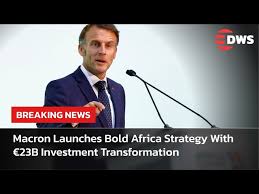
France is back — at least, that’s what Emmanuel Macron wants Africa to believe. At a glittering summit in Nairobi, the French president just dropped one of the biggest investment announcements in recent France-Africa history. Twenty-three billion euros. For the continent. With conditions, context, and controversy attached.
What Macron Announced
French President Emmanuel Macron unveiled a major €23 billion investment package for Africa during the Africa Forward Summit held in Nairobi, Kenya, signalling a renewed push by France to strengthen its economic and diplomatic ties with the continent. The announcement was made at the opening of the two-day summit, which brought together dozens of African heads of state, policymakers, and business leaders to discuss the continent’s economic future, innovation opportunities, and investment partnerships. Newsweek
Dozens of African heads of state. One room. One announcement. €23 billion.
Where Is the Money Coming From?
The €23 billion package — equivalent to approximately $27 billion — will target strategic sectors critical to Africa’s growth and long-term sustainability. The investment includes €14 billion from French public and private institutions, while an additional €9 billion will come from African investors, reflecting what Macron described as a more balanced economic relationship between both regions. Newsweek
So it is not purely French money. €9 billion of this package is African investor capital — which means Macron is essentially saying: we’ll put in our share if Africa puts in theirs. Whether you see that as genuine partnership or clever framing, that’s a conversation for your comment section.
For more world news affecting Africa and Nigeria, read our story on how the US reversed its visa freeze on Nigerian doctors.
What Sectors Get the Money?
The funding is expected to focus on sectors such as energy transition, digital technology, artificial intelligence, maritime development, and agriculture. Macron said the initiative could generate up to 250,000 direct jobs across Africa and France, boosting employment while deepening cross-continental collaboration. Newsweek
Energy. AI. Agriculture. Maritime. For a continent where energy poverty affects hundreds of millions of people and youth unemployment is a generational crisis — these are the right conversations to be having. Whether the money actually flows where it is promised is the real question Africa has learned to ask.
The “Equal Partnership” Pitch
Speaking before delegates at Nairobi’s convention centre, the French leader emphasized that the partnership should not be viewed as one-sided. Macron noted that France is not only seeking to invest in Africa, but also encouraging African entrepreneurs and major business leaders to expand their investments into France. According to him, this mutual economic exchange represents a new phase in France-Africa relations, one built on equal partnership and modern cooperation. Newsweek
Equal partnership. Modern cooperation. New phase. These are the words France needs Africa to hear right now — because the old relationship is in serious trouble.
Why France Needs This Moment So Badly
The Africa Forward Summit comes at a time when France is working to rebuild and redefine its relationship with African nations after years of strained diplomatic ties, particularly with several former French colonies where anti-French sentiment has grown in recent years. Newsweek
Mali. Burkina Faso. Niger. Senegal. Country after country across Francophone Africa has either expelled French troops, closed French military bases, or publicly turned away from Paris in recent years. The era of France’s unquestioned influence in its former colonies is over — and Macron knows it. This summit is France’s most visible attempt yet to pivot from that reality.
The Colonial Comment That Stirred the Pot
Macron being Macron, he couldn’t get through the summit week without saying something that would get people talking. Ahead of the summit, Macron sparked debate during an interview where he argued that colonialism should no longer be used as the sole explanation for Africa’s current challenges. He stated that while colonial history remains significant, African nations must also take responsibility for governance and development decisions made in the decades following independence. Newsweek
Macron added that European colonial powers should not be viewed as the primary “predators” shaping Africa’s modern economic realities — comments likely to generate mixed reactions across political and academic circles. Newsweek
And generate reactions they did. The timing — days before a summit where he needed African goodwill — raised more than a few eyebrows across the continent.
Stolen Artworks Are Going Back
On a warmer note, Macron used the summit to address one of Africa’s most emotionally charged demands. During his summit speech, Macron declared that the return of African artworks looted during the colonial era has become an irreversible process. His remarks come shortly after the French parliament passed legislation authorizing the return of looted African cultural artefacts currently held in French institutions, marking another step in France’s attempt to address longstanding historical grievances. Newsweek
Bronzes, sculptures, masks — pieces of African history that have sat in French museums for over a century. The legislation is passed. The process has begun. For many Africans, this is the most meaningful gesture France has made in years — because it costs France something real.
The Bigger Competition Behind the Pledge
Make no mistake — this €23 billion announcement is not happening in isolation. As global powers increasingly compete for influence on the continent, Macron’s €23 billion pledge is expected to position France more aggressively in Africa’s fast-growing markets while attempting to repair and modernize a relationship long shaped by history. Newsweek
China has been investing in African infrastructure for decades. The US has its own Africa strategy. Gulf states are pouring money into the continent. Russia has expanded its military presence in the Sahel. France — once the dominant external power across much of Africa — is now scrambling to stay relevant in its own backyard.
€23 billion is a big number. But for Africa, the question has never been about the size of the pledge. It has always been: who benefits, on whose terms, and who controls the outcome?
The continent is listening, Macron. But Africa has heard big promises before. 🌍