



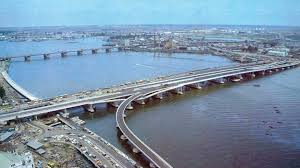
One of Lagos’ most iconic and most troubled bridges is finally getting a complete overhaul. The Federal Government has approved N548.98 billion to demolish and rebuild Carter Bridge from scratch. Here is everything Lagos residents and Nigerians in the diaspora need to know.
The Decision Is Final — Demolish and Rebuild
Minister of Works Dave Umahi announced the decision after Thursday’s Federal Executive Council meeting. The Carter Bridge will not be repaired. It will be demolished completely and rebuilt from the ground up.
This decision did not come lightly. Technical investigations carried out in 2013, 2019 and again under the current administration all reached the same conclusion — the bridge’s underwater foundations have deteriorated beyond repair.
Experts found severe damage to the piles and pile caps beneath the water line. Both local and international engineers agreed unanimously. Rehabilitation is no longer an option. The bridge must go.
Who Is Building the New Bridge?
The reconstruction contract was awarded to the China Civil Engineering Construction Corporation — CCCC — after a competitive bidding process. Other major firms that competed included Julius Berger, CCECC, CBC and China Harbour High Tech.
CCCC is one of China’s largest infrastructure companies with a track record of major bridge and highway projects across Africa. Their involvement connects directly to Nigeria’s deepening China partnership — the same relationship that recently produced the NNPCL-Chinese firms refinery deal we reported earlier.
how the World Bank selected Abia State for a $700 million water and sanitation project
The New Bridge Will Be Bigger and Better
The reconstruction is not just a replacement. It is a full redesign and expansion.
The current Carter Bridge stretches 1.525 kilometres. The new bridge will extend to 1.93 kilometres — significantly longer. A new flyover ramp will be added specifically to eliminate one of the worst traffic bottlenecks in the area. The new structure will also include a navigational waterway spanning 105 metres by two — improving maritime access beneath the bridge for Lagos Lagoon traffic.
Third Mainland Bridge Gets Attention Too
The Federal Executive Council also approved N24.89 billion for underwater component work on the Third Mainland Bridge. Julius Berger secured that contract.
Two of Lagos’ most critical bridges getting major structural work simultaneously is significant. Both structures serve millions of commuters daily and have raised safety concerns for years.
Why Carter Bridge Matters So Much
Carter Bridge connects Lagos Island to the mainland. Every day thousands of Lagosians cross it — commercial vehicles, motorcycles, pedestrians, traders. It is one of the main arteries keeping Lagos’ economy moving.
The bridge was originally named after Gilbert Carter, a former British Governor of the Lagos Colony. It has served Lagos for decades — far longer than its design likely intended. Constant heavy traffic, age and the corrosive salt water of the Lagos Lagoon have taken their toll.
Previous administrations restricted heavy vehicles on the bridge and carried out patch repairs. But the deterioration continued. Today’s decision reflects the reality that patchwork maintenance has finally run out of road.
What Lagos Residents Should Expect
The reconstruction will cause traffic disruption. There is no way around this. Any major construction on a bridge this critical to Lagos traffic will create pressure on alternative routes — particularly the Third Mainland Bridge and Eko Bridge.
Lagos State and Federal authorities will need to plan alternative traffic management carefully to prevent the construction period from becoming a permanent gridlock nightmare.
However the long term gain is clear. A rebuilt, expanded Carter Bridge with modern foundations, better traffic flow design and improved maritime access will serve Lagos for decades to come.
The Bigger Picture — Nigeria Is Building
This Carter Bridge approval comes alongside the World Bank’s $700 million investment in Abia State water infrastructure, the NNPCL refinery revival deal, and Abia’s new solar energy projects. Nigeria’s infrastructure development is accelerating across multiple fronts simultaneously.
Read our full story on [how the World Bank selected Abia State for a $700 million water and sanitation project] — another major infrastructure win for Nigeria this week.
GossipShop Verdict
N548.98 billion to rebuild Carter Bridge is a massive commitment. The decision to demolish rather than patch is the right call — previous patches have only delayed the inevitable while putting lives at risk.
Lagos deserves a world-class bridge connecting its island to its mainland. If CCCC delivers on time and to specification — and that is the critical test — this project will be one of the most impactful infrastructure investments in Lagos history.
The proof will be in the concrete. 🇳🇬🌉